
You invite three estate agents to value your home, and they come back with three completely different numbers. One says £320,000, another says £350,000, and the third says £375,000. Which one do you trust? This is one of the most stressful moments in the selling process, and it happens to homeowners across the UK every single day. The good news is that comparing valuations does not have to be a guessing game. With the right framework, you can cut through the noise, spot inflated estimates, and land on a realistic asking price that actually sells.
Table of Contents
- Why property valuations differ between estate agents
- What you need before comparing agent valuations
- Step-by-step: How to compare property valuations effectively
- Spotting red flags and common pitfalls
- Double-checking your chosen valuation
- Confidently compare property valuations with StreetVal
- Frequently asked questions
Key Takeaways
| Point | Details |
|---|---|
| Gather multiple valuations | Request at least three estate agent estimates and collect recent sold price data before deciding. |
| Check evidence behind prices | Compare valuation rationales, looking for real sales data and clear adjustments for your home's features. |
| Beware unrealistic estimates | Extremely high or low valuations can signal issues—choose the figure that data supports, not just the biggest number. |
| Verify using independent sources | Always cross-reference agent suggestions with portals like Rightmove and the HM Land Registry. |
Why property valuations differ between estate agents
Understanding why valuations can differ is the first step to making sense of the numbers you receive.
Every agent approaches your home with a slightly different lens. Most rely on the comparable sales method, which means they look at recent sold prices of similar properties nearby and then adjust for differences like your home's condition, size, and location. The problem is that those adjustments are partly subjective. One agent might add £15,000 for your new kitchen. Another might add £8,000. Neither is necessarily wrong, but the gap adds up fast.
There is also a commercial incentive at play. Some agents deliberately quote a high figure to win your listing, a tactic known as "buying the instruction." They know a flattering number is hard to resist. But once your home sits on the market without offers, the pressure to reduce the price begins. Research shows that homeowners overestimate by 16% on average, which means inflated agent estimates can feel believable even when they are not grounded in data.
Here is what agents typically factor into their estimates:
- Recent sold prices of comparable homes within a half-mile radius
- Property size, layout, and number of bedrooms
- Condition, age, and quality of fixtures and fittings
- Proximity to schools, transport links, and local amenities
- Current supply and demand in your specific postcode
"An overvalued home does not just sit longer on the market. It signals to buyers that something might be wrong, which can make the eventual price drop feel even more damaging to your negotiating position."
For a deeper look at how agents arrive at their figures, our property valuation guide walks through the full process. You can also check the latest trends in our UK property market insights to understand how current conditions affect estimates.
What you need before comparing agent valuations
Once you know why estimates can vary, the next step is preparing the right information to compare them fairly.
Walking into a valuation comparison without your own data is like negotiating a car price without knowing the market rate. You need benchmarks. The strongest ones come from actual sold prices, not asking prices, because asking prices reflect hope while sold prices reflect reality.

You can verify valuations independently using Rightmove, Zoopla, and HM Land Registry. Focus on sales completed within the last six months, since older data may not reflect current market conditions. Filter by property type, number of bedrooms, and street or postcode to get the most relevant comparisons.
Here is a quick checklist of what to prepare before your valuation meetings:
- A list of recent sold prices for similar homes within half a mile
- Notes on any improvements you have made (new boiler, loft conversion, updated bathrooms)
- Details of any drawbacks (busy road, small garden, no parking)
- Questions about how each agent plans to market your home
- A target timeline for your sale
| Data source | What it shows | Best used for |
|---|---|---|
| HM Land Registry | Official sold prices | Most accurate benchmark |
| Rightmove sold prices | Recent local sales with photos | Visual comparison |
| Zoopla estimates | Automated value range | Quick sense check |
| Agent valuation | Professional opinion | Starting point only |
Pro Tip: Do not rely on a single source. Cross-reference at least two or three data points before you sit down with any agent. This puts you in a much stronger position to challenge figures that seem off.
When you are ready to start reaching out, our guide on how to choose an estate agent can help you identify who is worth inviting to value your home.
Step-by-step: How to compare property valuations effectively
With your data gathered, you are ready to analyze agent valuations using a side-by-side approach.
- Collect at least three valuations. One or two is not enough to spot a pattern. Three gives you a range and helps you identify outliers immediately.
- Ask each agent to explain their reasoning. A good agent will walk you through the comparable sales they used. If they cannot name specific sold properties, that is a warning sign.
- Rank the valuations from lowest to highest. Note the spread. A gap of £10,000 to £20,000 is normal. A gap of £50,000 or more deserves serious scrutiny.
- Compare each estimate against your independent research. If your own data suggests £330,000 and one agent says £390,000, ask them to justify the difference with specific evidence.
- Adjust for your property's unique features. If your home has a large garden, a garage, or a recent extension, make sure each agent has accounted for those in their estimate.
Here is a simple comparison table you can fill in after your valuations:
| Agent | Valuation | Comparable properties cited | Marketing plan | Fee |
|---|---|---|---|---|
| Agent A | £330,000 | 3 local sales | Rightmove + social | 1.2% |
| Agent B | £355,000 | 1 local sale | Rightmove only | 1.0% |
| Agent C | £375,000 | None provided | Rightmove + Zoopla | 1.5% |
In this example, Agent C's valuation is the highest but comes with the least evidence. That is a red flag, not a reason to celebrate. The comparable sales method only works when agents actually use real, recent data to back their numbers.
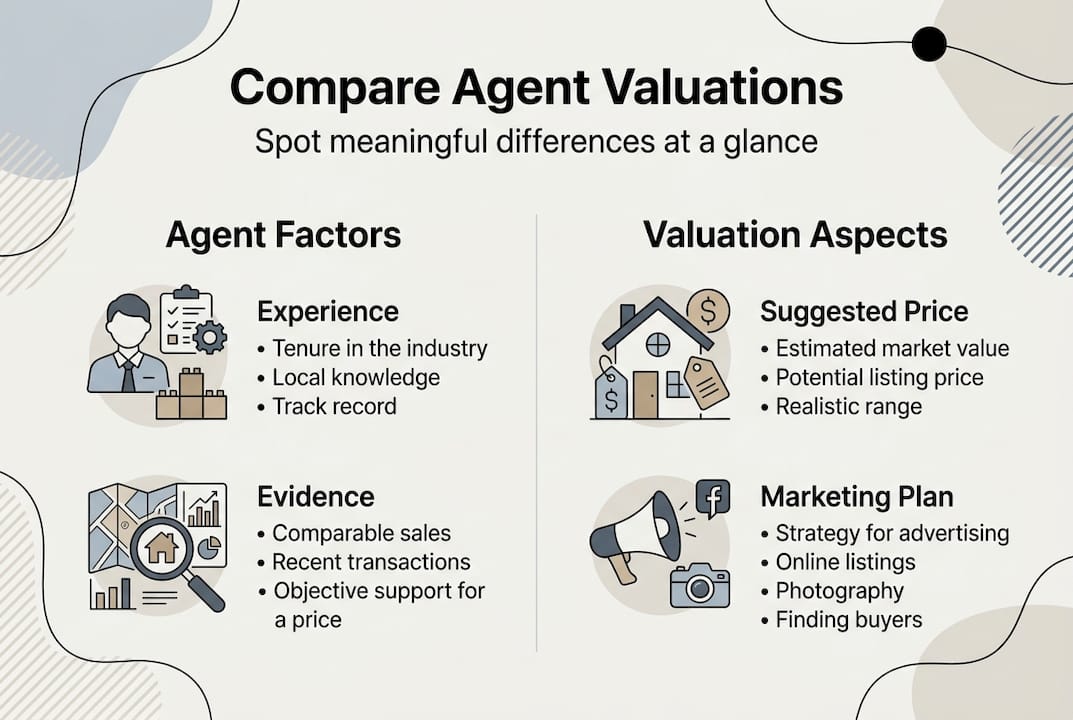
If you are weighing up different types of agents, our breakdown of online vs high street agents covers the key differences. And if you want to strengthen your position before valuations, our tips to boost value before selling are worth reading first.
Spotting red flags and common pitfalls
While comparing, stay alert for signs that an agent's valuation could hurt your sale.
Not every high valuation is a gift. Some are traps. An agent who quotes £40,000 above the market average without solid evidence is likely buying the instruction, hoping the flattering number wins your business. Once you are locked in and the offers do not come, you face a painful choice: reduce the price or wait.
Watch out for these warning signs:
- No comparable sales cited. If an agent cannot point to specific sold properties, their number is an opinion, not an estimate.
- Valuation significantly above your own research. A 10% gap might be explainable. A 20% gap needs hard evidence.
- Pressure to sign quickly. Reputable agents give you time to think.
- Vague marketing plans. A high asking price means nothing without a strong plan to reach buyers.
- Multiple high valuations with no supporting data. If every agent is quoting high without evidence, the market may not support those prices.
"The agent who tells you what you want to hear is not always the agent who will get you the best result. The one who brings real data, even if the number is lower, is often the safer choice."
Pro Tip: Ask each agent what they would recommend if your home has not received an offer within four weeks. Their answer tells you a lot about how realistic their valuation really is.
Understanding estate agent fees is also important here, since a higher fee does not guarantee a better result. And if you want to understand how surveys can affect your final sale price, our guide on property surveys and selling is a useful read.
Double-checking your chosen valuation
After filtering out red flags, it is time to lock in your chosen value and prepare for your sale.
Choosing a valuation is not the end of the process. It is the beginning of a new one. Before you commit to an asking price, run one final check against the data.
- Pull the three most recent sold prices for comparable homes in your street or postcode from HM Land Registry or Rightmove.
- Adjust for your property's differences. Bigger garden? Add a modest premium. No parking? Subtract accordingly.
- Check current active listings. If similar homes are sitting unsold at a certain price, that is a ceiling, not a target.
- Confirm your agent's marketing plan. A realistic price paired with strong marketing is far more powerful than an optimistic price with minimal exposure.
You can verify your chosen figure at any point using sold price data from Rightmove, Zoopla, or HM Land Registry. Make it a habit to recheck every few weeks once your home is listed, especially if feedback from viewings suggests buyers feel the price is too high.
Pro Tip: Set a clear review date with your agent, say four weeks after listing. If you have not received serious interest by then, revisit the price together using fresh sold data rather than waiting and hoping.
For a complete walkthrough of the valuation process from start to finish, our full property valuation guide covers everything you need to know.
Confidently compare property valuations with StreetVal
If you are ready to put these steps into action, there is a tool designed to speed up and simplify your valuation comparisons.
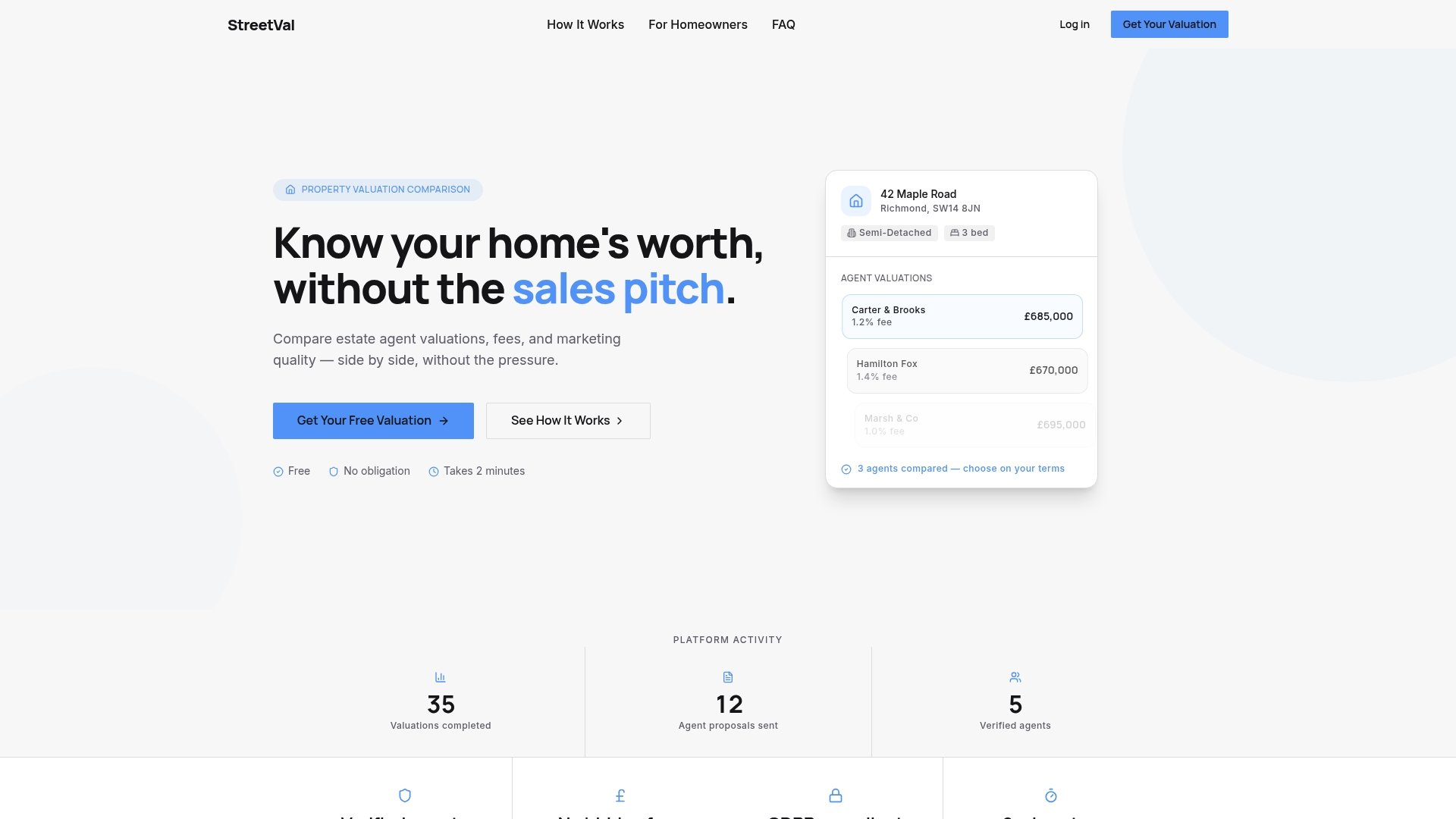
StreetVal is built specifically for UK homeowners who want to compare multiple local estate agent valuations in one place, without the pressure of committing to anyone. Instead of booking separate appointments and trying to remember who said what, you get a clear, side-by-side view of estimates, fees, and agent credentials. Our platform for homeowners is designed to give you the data you need to make a confident, informed decision. Want to see exactly how StreetVal works? The process takes just a few minutes and puts you firmly in control of your sale from day one.
Frequently asked questions
What is the most accurate way to value my property?
The most accurate method is comparing your home to recent local sales using sources like HM Land Registry and adjusting for your property's unique features. No automated tool or single agent opinion can replace real sold data from your immediate area.
How many estate agent valuations should I get before selling?
Aim for at least three separate valuations to spot inconsistencies and build a clearer picture of true market value. One or two estimates simply do not give you enough range to identify outliers.
Why do some estate agents inflate their valuations?
Some agents overvalue to win your business, a practice called buying the instruction, which often leads to price reductions and longer time on the market. Always ask for the comparable sales data behind any estimate.
Should I always choose the highest valuation?
No. The highest estimate may not reflect what buyers will actually pay, and an overvalued listing often ends up needing a price cut that damages buyer confidence. Choose the valuation best supported by real sold data.
Where can I check recent property sale prices in my area?
You can use Rightmove, Zoopla, and HM Land Registry to view recent sold prices near your address. Focus on sales from the last six months for the most relevant benchmarks.